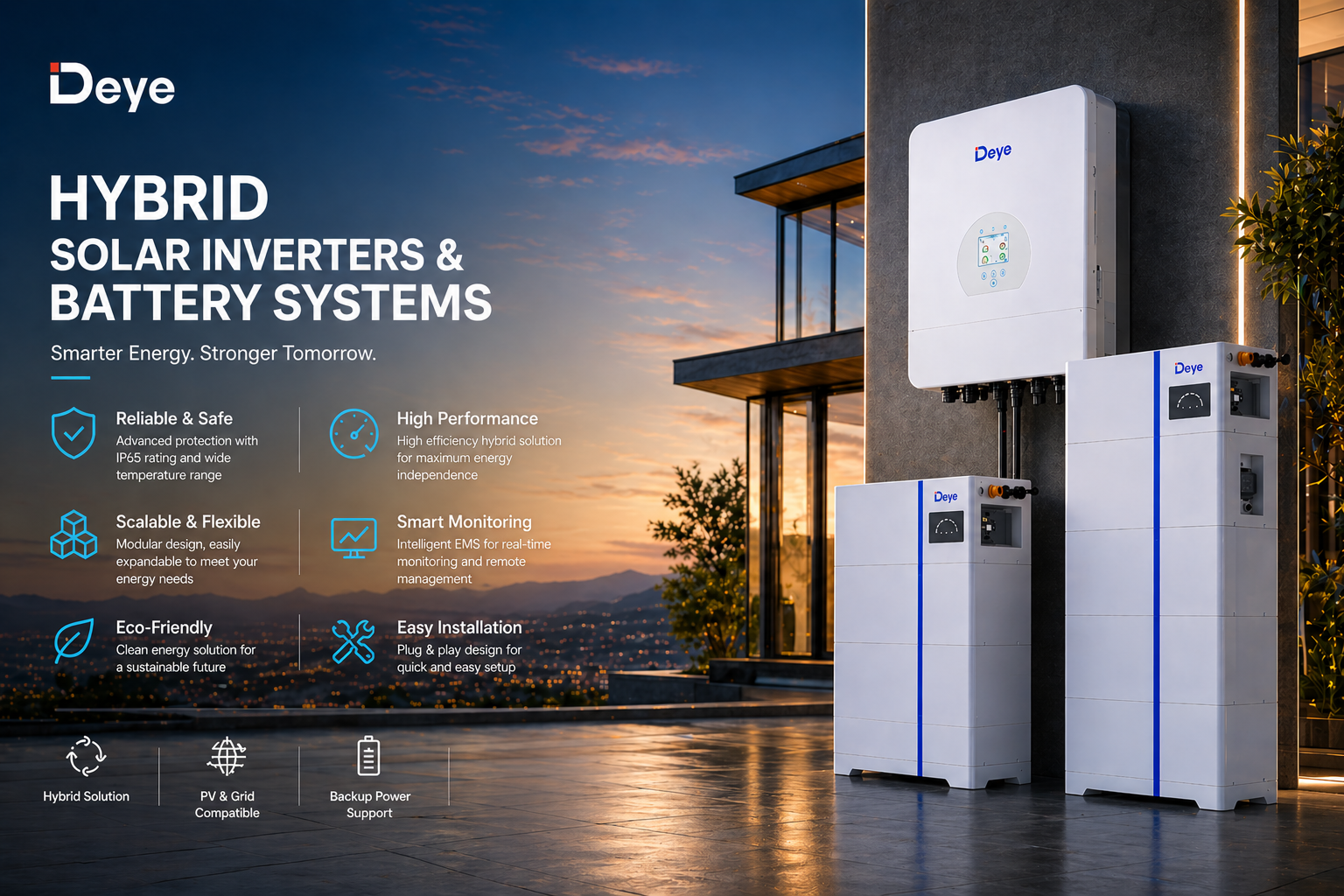
Introduction to Deye Hybrid Solar Inverters & Battery Systems:
The Deye Hybrid Solar Inverters & Battery Systems have become one of the most widely deployed energy storage solutions across Asia, Africa, Europe, and emerging markets. Unlike generic inverter solutions, Deye systems are known for robust engineering, high scalability, and detailed technical specifications that are publicly documented and field-tested.
Manufactured by Ningbo Deye Inverter Technology Co., Ltd., the company is part of the larger Deye Group, a publicly listed enterprise in China. Deye entered the inverter market with a strong focus on energy storage hybrid inverters, and today it is recognized as one of the leading suppliers in off-grid and hybrid solutions.
About Deye as a Global Manufacturer:
Deye exports its inverters to more than 100 countries and has established a strong reputation in markets where:
- Grid reliability is low
- Load-shedding is common
- Energy independence is critical
The company’s manufacturing is supported by automated production lines and strict quality control processes, ensuring consistency in product performance.
What Are Deye Hybrid Solar Inverters & Battery Systems?
Core Working Principle
The Deye Hybrid Solar Inverters & Battery Systems integrate three essential energy components:
- Solar power conversion (DC to AC)
- Battery storage management
- Grid interaction
This allows the system to intelligently distribute energy between solar panels, batteries, loads, and the utility grid.
Hybrid vs Traditional Inverter Systems
Traditional inverters only convert solar energy for immediate use or grid export. In contrast, Deye hybrid systems:
- Store excess energy in batteries
- Provide backup power during outages
- Enable time-of-use energy optimization
Deye Hybrid Inverter Product Range:
Single-Phase Hybrid Inverters
Deye offers single-phase hybrid inverters such as:
- SUN-3K-SG04LP1
- SUN-5K-SG04LP1
These are designed for residential use and operate on 48V low-voltage battery systems.
Three-Phase Hybrid Inverters
Popular models include:
- SUN-8K-SG04LP3
- SUN-12K-SG04LP3
- SUN-20K-SG01HP3 (High Voltage)
These systems support larger installations and commercial applications.
Low Voltage vs High Voltage Systems
- Low Voltage (48V): Safer, commonly used in homes
- High Voltage (160V–800V): Higher efficiency, used in commercial systems
Deye Battery Systems Overview:
Lithium Battery Technology Used
Deye primarily supports Lithium Iron Phosphate (LFP) batteries due to:
- High thermal stability
- Long lifecycle (6000+ cycles)
- Enhanced safety
BOS-G and SE-G Series Batteries
Deye battery solutions include:
- SE-G5.1 Pro: ~5.12 kWh capacity per module
- BOS-G Series: High-voltage scalable systems
These batteries are modular and can be expanded based on energy requirements.
Technical Specifications:
Power Ratings and Output
- Residential models: 3 kW – 6 kW
- Commercial models: 8 kW – 50 kW+
Some high-end models support parallel operation up to 16 units, enabling megawatt-scale systems.
Efficiency and MPPT Data
- Maximum efficiency: up to 97.6%
- European efficiency: ~97%
- MPPT trackers: 2 to 4 depending on model
MPPT voltage range typically spans 150V – 850V, depending on inverter type.
Battery Voltage and Capacity Range
- Low-voltage systems: 40V – 60V (nominal 48V)
- High-voltage systems: 160V – 800V
Battery capacity is scalable from 5 kWh to 100+ kWh in larger installations.
How Deye Hybrid Solar Systems Work:
Solar Energy Conversion
Photovoltaic panels generate DC electricity, which is converted into AC power through a high-efficiency inverter stage.
Battery Storage and Discharge
Excess solar energy is stored in connected battery systems. During low solar production:
- Energy is discharged from batteries
- System prioritizes stored energy before grid usage
Grid Interaction and Backup Function
Deye hybrid inverters support:
- Grid export (net metering)
- Grid import when needed
- Seamless switching to backup mode within milliseconds
A key feature is UPS-level switching (<10 ms), ensuring uninterrupted power for sensitive loads.
Performance and Efficiency Analysis:
Maximum Efficiency Figures
With peak efficiency around 97.6%, Deye systems are competitive with top-tier inverter brands.
Real-World Performance Metrics
In field conditions:
- Stable output under high temperatures
- Reliable performance in weak grid environments
- Efficient battery utilization
Parallel and Scalability Capabilities
Deye supports:
- Parallel connection of up to 16 units
- Microgrid capability
- Load sharing between multiple inverters
Safety Features and Certifications:
Protection Systems
Deye systems include:
- Overvoltage and overcurrent protection
- Short-circuit protection
- Anti-islanding protection
- Reverse polarity protection
International Compliance Standards
Deye inverters comply with:
- IEC 62109 (safety)
- IEC 61727 (grid connection)
- CE certification
- Various regional grid codes
Smart Monitoring and Control:
Deye Smart Monitoring Platform
Deye provides a cloud-based monitoring system that allows:
- Real-time energy tracking
- Fault detection
- Remote firmware updates
Remote Management Features
Users and installers can:
- Monitor system performance remotely
- Adjust settings
- Diagnose issues without on-site visits
Installation and System Design:
Installation Requirements
Deye inverters are designed for:
- Indoor and outdoor use
- IP65 protection rating
System Configuration and Expansion
Systems can be configured based on:
- Load requirements
- Battery capacity
- Solar generation
Expansion is straightforward due to modular design.
Advantages of Deye Hybrid Solar Inverters & Battery Systems:
Reliability and Durability
Deye systems are widely used in regions with harsh conditions, proving their durability and stability.
Cost Efficiency
Compared to premium brands, Deye offers:
- Lower upfront cost
- High performance-to-price ratio
Comparison with Competitors:
Deye vs FoxESS
Compared to FoxESS:
- Deye offers stronger off-grid capabilities
- Better scalability for large systems
Deye vs GoodWe
Compared to GoodWe:
- Deye is more suitable for backup-heavy environments
- Better parallel support
Applications of Deye Systems:
Residential Use
- Homes
- Villas
- Apartments
Commercial and Industrial Use
- Factories
- Offices
- Agricultural setups
Cost, Warranty, and ROI:
Pricing Structure
Deye systems are positioned in the mid-range pricing category, making them accessible for a wide range of users.
Warranty and Lifespan
- Standard warranty: 5–10 years
- Lifespan: 10–15 years
FAQs About Deye Hybrid Solar Inverters & Battery Systems:
1. What is the efficiency of Deye hybrid inverters?
Up to 97.6% maximum efficiency.
2. Are Deye systems suitable for off-grid use?
Yes, they are widely used in off-grid and hybrid setups.
3. What battery types are supported?
Primarily LFP lithium batteries.
4. Can the system be expanded?
Yes, both inverter and battery systems are scalable.
5. Does it support parallel operation?
Yes, up to 16 units depending on the model.
6. Is remote monitoring available?
Yes, via Deye cloud platform.